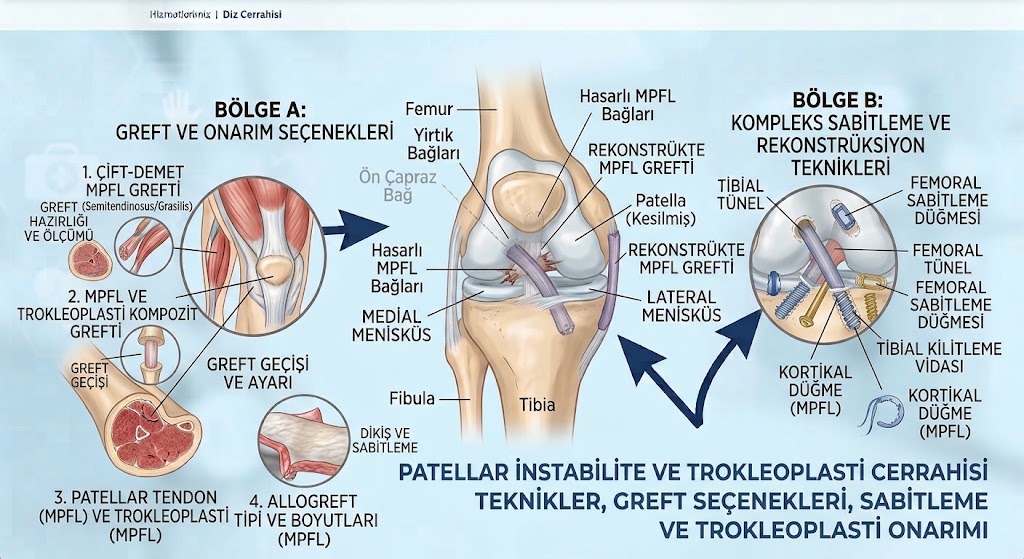
Patellar (Kneecap) Dislocation and Instability
Last updated: 03 Eylül 2026
Instability characterized by the kneecap (patella) slipping out of its normal groove and recurrent dislocations is seen especially in young, active individuals.
What Is Patellar Instability?
The kneecap (patella) glides within a groove on the thigh bone during knee movement. It slipping out of this groove (dislocation/subluxation) usually occurs in young individuals with flexible joints, typically with a sudden twisting motion while the knee is bent; the risk of recurrence is high after a first dislocation.
What Are the Symptoms?
- Severe pain at the moment the kneecap dislocates
- Marked swelling of the knee
- A sensation that "my kneecap is slipping/about to dislocate"
- Pain and insecurity with movements such as going down stairs or squatting
How Is It Diagnosed?
Patellar mobility and alignment abnormalities are assessed during examination. MRI is used to evaluate intra-articular cartilage damage and the condition of the stabilizing MPFL ligament; additional imaging may be needed in some cases to assess alignment abnormalities.
Treatment Options
Conservative treatment may be tried after a first dislocation, restoring muscle balance with physical therapy. In recurrent dislocations, patellar stabilization is achieved with MPFL reconstruction; if there is an underlying significant alignment abnormality, additional surgical procedures (such as tibial tubercle osteotomy) may be planned.
This content is provided for general health information purposes only and does not replace medical diagnosis or treatment. Please consult a physician for your health concerns.
Would You Like to Book an Appointment?
Contact us for more information about this condition or to schedule an appointment.
Book Appointment