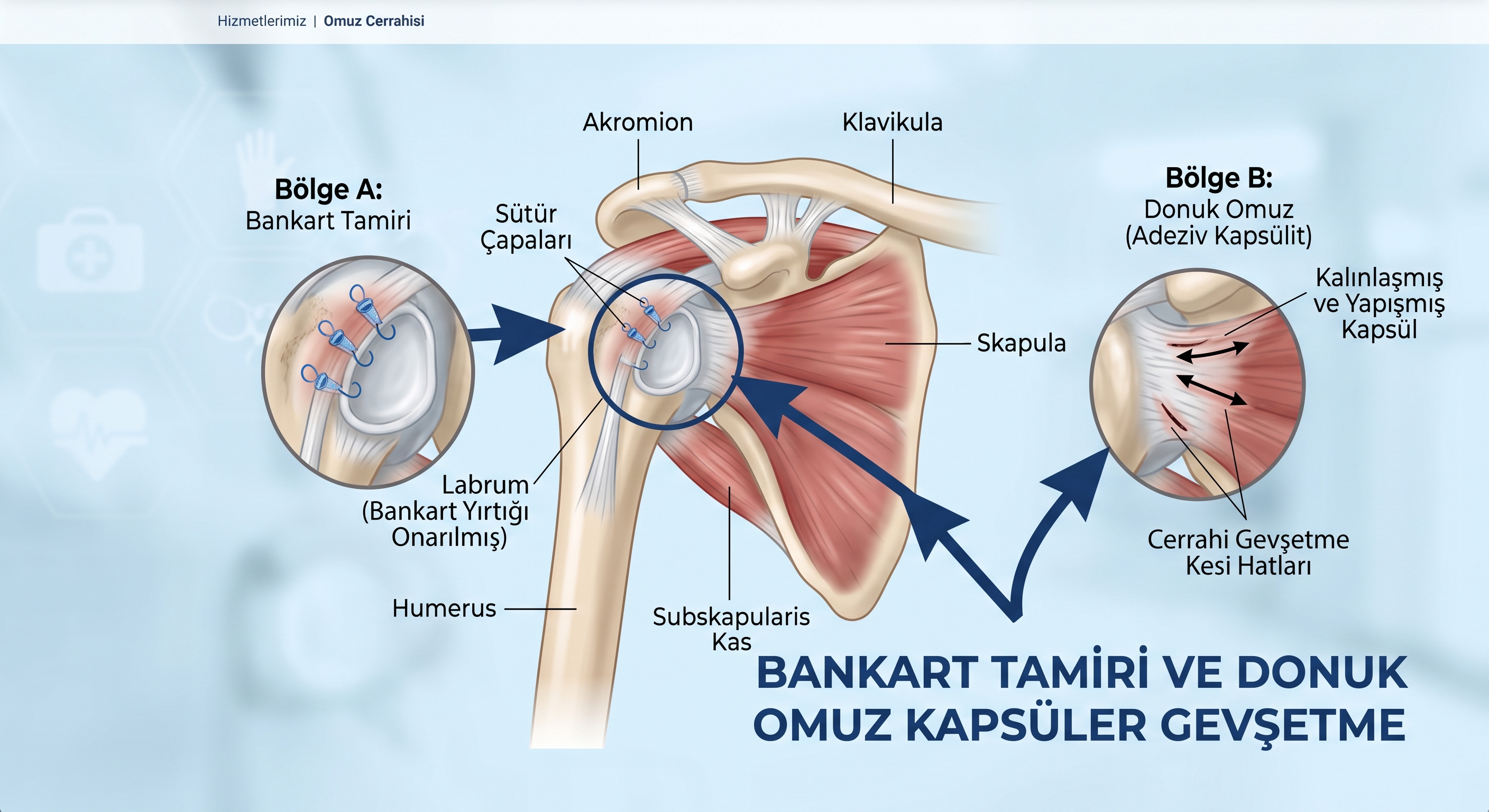
Frozen Shoulder (Adhesive Capsulitis)
Last updated: 03 Eylül 2026
Frozen shoulder, caused by thickening and stiffening of the shoulder joint capsule, progresses with painful and gradually increasing restriction of motion.
What Is Frozen Shoulder (Adhesive Capsulitis)?
Frozen shoulder is a condition characterized by marked restriction of shoulder motion, resulting from inflammation, thickening and eventual stiffening of the capsule surrounding the shoulder joint. It is more common in people with diabetes, after prolonged immobility, and between the ages of 40 and 60.
What Are the Symptoms?
- Gradually increasing shoulder pain that worsens at night
- Progressively increasing restriction when moving the shoulder in any direction
- Difficulty with everyday movements such as combing hair or fastening a bra
- Generally progresses through three stages: freezing, frozen and thawing
How Is It Diagnosed?
Diagnosis is largely based on examination; restriction of both active and passive range of motion is typical. Imaging methods are usually used to rule out other shoulder pathologies.
Treatment Options
Most cases improve over time with physical therapy, stretching exercises and, when needed, intra-articular injections. In long-standing cases resistant to physical therapy, range of motion can be rapidly restored with closed (arthroscopic) capsular release.
This content is provided for general health information purposes only and does not replace medical diagnosis or treatment. Please consult a physician for your health concerns.
Would You Like to Book an Appointment?
Contact us for more information about this condition or to schedule an appointment.
Book Appointment