Meniscus Repair
What is the meniscus?
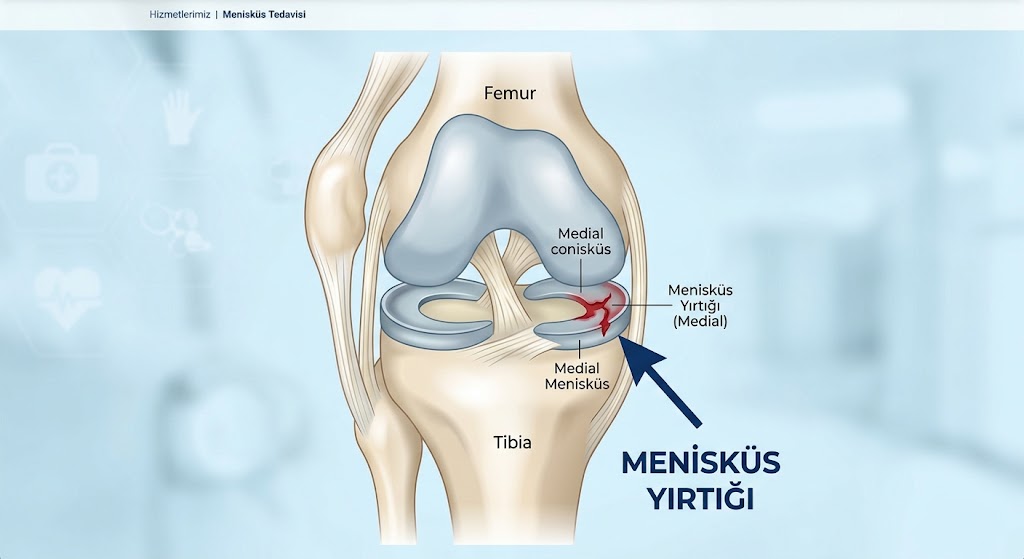
The menisci are cartilage-like structures located in the knee joint. They play vital roles such as load transfer, shock absorption, distribution of joint fluid and deep sensory transmission in the knee. Each knee has two menisci, one on the inner side and one on the outer side.
How do menisci tear?
Menisci usually tear after a sudden twisting of the knee or a fall. A meniscus tear can occur in anyone; at a young age it typically results from high-energy trauma. With advancing age, the menisci undergo wear and degeneration, which makes tearing easier.
Medial (inner) meniscus tears are more common than lateral (outer) tears. This is because the lateral meniscus is more mobile and better able to avoid trauma. However, tears accompanying an anterior cruciate ligament rupture occur more often in the posterior part of the lateral meniscus.
How are meniscus tears classified?
Depending on their shape, meniscus tears are classified as longitudinal (vertical), horizontal, oblique, radial and complex tears (flap-type, complex and degenerative tears). The shape of the tear is one of the factors that affects the choice and success of treatment.
What symptoms does a meniscus tear cause?
Pain occurs on the inner or outer side of the knee after the injury. There may or may not be swelling immediately after the trauma. If the torn fragment is large and continues to move with knee motion, there may be pain, swelling and a catching sensation in the knee. Sometimes this catching cannot resolve on its own and urgent surgical intervention may be needed.
How is a meniscus tear diagnosed? During examination, a preliminary diagnosis of meniscus tear can usually be made, and the tear is confirmed by MRI. MRI also provides information about the location, shape and size of the tear, and identifies any accompanying ligament or cartilage injuries.
How are meniscus tears treated? Treatment of meniscus tears is determined according to the location, shape, size of the tear and the symptoms it causes. Not all tears require surgery. Age and the patient's activity level are very important in decision-making. Tears smaller than 1 cm that do not cause mechanical symptoms are generally followed with rehabilitation and injections. Large tears and tears causing locking require surgical treatment.
What is arthroscopy? How is it performed? Arthroscopy is the visualization of the inside of the joint with a camera through small incisions (approximately 0.5 cm). It can be performed under regional or general anesthesia. The structures inside the knee are visualized, pathologies are identified, and targeted treatments can be performed without opening the joint. Meniscus tears are trimmed or repaired with various instruments. Accompanying ligament and cartilage problems can be treated at the same time.
Will my meniscus tear be repaired or removed? Since the menisci are vital structures for the knee, every effort is made to preserve them. The meniscus is never removed entirely. In certain tear types, if the torn fragment is in the avascular (poorly vascularized) zone of the meniscus, it is known that even if repaired it would not heal, so a small portion is removed, while the vascularized area is always repaired. Meniscus repair technique varies depending on the type of tear.
What happens after surgery? A single overnight stay is usually sufficient after arthroscopy. Patients can get up and walk the same evening. Depending on the intervention performed for the tear, use of crutches may be required, generally for no more than four weeks. Movement and rehabilitation begin immediately after surgery. Office workers can usually return to work after one week. Rehabilitation duration and return-to-sport time can vary depending on the intervention performed for the tear.
Would You Like to Book an Appointment?
Contact us for more information about this service or to schedule an appointment.
Book Appointment